
Lord Nelson’s Strange Journey Home
The Admiral, the Barrel, and the Curious Business of Preserving a Hero
October 21, 1805. Somewhere off the coast of Spain.
There are many ways for a great man to return home from war.
Some arrive to the thunder of cannon, the cheers of grateful countrymen, and the embrace of a waiting sweetheart.
Others return rather more quietly.
And then there was Admiral Horatio Nelson.
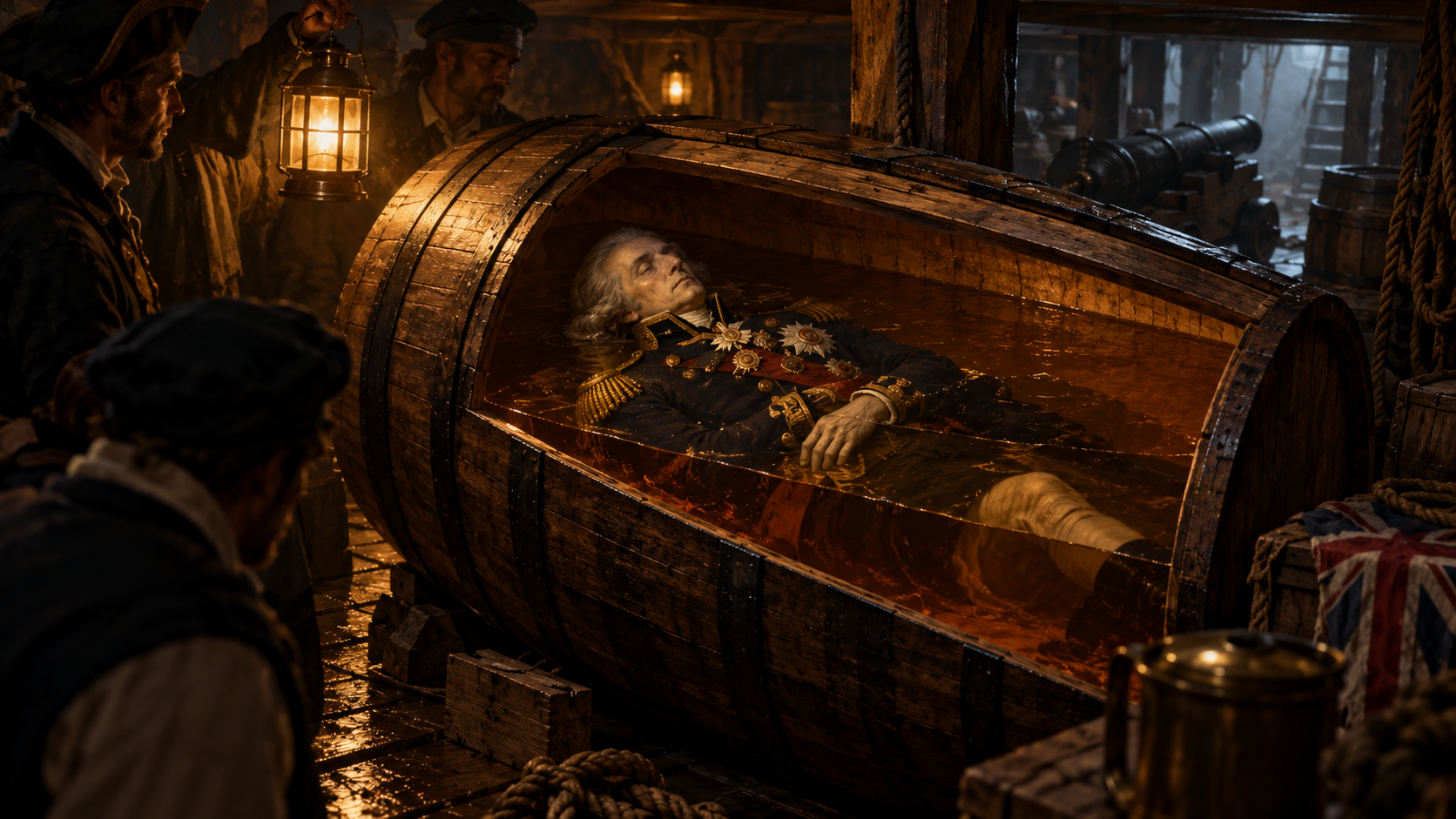
Lord Nelson’s body in a barrel of brandy began one of history’s strangest journeys home.
But perhaps we should begin at the beginning. After all, it would be terribly impolite to consign our distinguished guest to a barrel before properly introducing him.
A Most Inconvenient Victory
The Battle of Trafalgar was, by almost any measure, a magnificent British triumph.
Twenty-seven British ships under the command of Vice-Admiral Lord Nelson engaged a combined French and Spanish fleet of thirty-three vessels. The stakes were enormous. Napoleon Bonaparte dominated much of continental Europe, and control of the seas was among Britain’s greatest defenses against French ambitions.
Nelson, already a national hero, had devised a daring plan to break the enemy’s battle line.
And it worked.
Unfortunately, victory and survival are not always acquainted.
At approximately 1:15 that afternoon, as HMS Victory fought at close quarters with the French ship Redoutable, a musket ball struck Nelson in the left shoulder. It tore through his chest, damaged his spine, and left him mortally wounded.
The admiral fell upon the deck of the ship whose very name now seemed to mock him.
He was carried below, where the ship’s surgeon, William Beatty, examined the wound.
Nelson understood what had happened. He knew he was dying.
Above him, the battle raged. Cannons roared, timbers splintered, and men screamed. Below decks, the man responsible for Britain’s greatest naval victory lay waiting for death.
He survived for roughly three hours after being shot.
Among his last concerns were his country, his loved ones, and the outcome of the battle.
His duty, as he saw it, had been fulfilled.
His earthly troubles, however, were only beginning.
The Problem of a Dead Admiral
Now, dear reader, we arrive at a rather delicate question.
What does one do with a dead national hero aboard a warship, hundreds of miles from home?
In the Royal Navy of 1805, the answer for an ordinary sailor was generally straightforward.
A burial at sea.
The body would be sewn into a hammock or shroud, weighted, and committed to the deep. It was a practical arrangement. Warships had neither the space nor the facilities to accommodate the deceased for very long.
The ocean was a vast and accommodating cemetery.
But Nelson was no ordinary sailor.
He had expressed a wish to be buried in England, and his officers intended to honor it.
There was, regrettably, a complication.
England was far away.
The Victory had suffered terrible damage during the battle. The fleet had to contend with severe weather, damaged ships, wounded men, and the aftermath of combat. The journey home would not be swift.
And while the dead may be exceedingly patient, nature is not.
Without refrigeration or effective preservation, Nelson’s remains would begin to decay long before reaching British shores.
Surgeon Beatty therefore faced an extraordinary assignment.
He had to keep a dead admiral presentable.
For weeks.
At sea.
And so he turned to an unlikely ally.
Brandy.
A Barrel Fit for a Hero
Beatty selected one of the largest casks available aboard the Victory, a vessel known as a leaguer.
Nelson’s body was prepared, his hair cut, and his clothing removed except for his shirt.
Then the remains of Britain’s most celebrated naval commander were placed inside the enormous cask.
The barrel was filled with brandy.
Not wine.
Not water.
And, contrary to the popular retelling, not rum.
Brandy.
Beatty considered it preferable to rum for preserving human remains. Alcohol, in sufficient concentration, could slow the processes of decomposition.
The arrangement was undeniably practical.
It was also rather extraordinary.
Somewhere aboard a battered British warship, surrounded by wounded sailors and the wreckage of battle, stood a barrel containing the body of the man who had just saved Britain from the threat of Napoleon’s fleet.
The admiral who had commanded ships, conquered enemies, and become the pride of a nation was now cargo.
Very important cargo, certainly.
But cargo nonetheless.
One imagines the quartermaster would have preferred not to explain this particular addition to the ship’s stores.
The Admiral’s Last Drink
Naturally, a story involving sailors, alcohol, and a dead admiral could hardly escape the attentions of folklore.
According to a popular legend, thirsty sailors secretly drilled into Nelson’s barrel and drank the preserving spirits, unaware—or perhaps perfectly aware—of what floated within.
Some versions claim that the liquid became known as Nelson’s Blood, a nickname associated with naval rum.
It is a marvelous tale.
It is also one that deserves a raised eyebrow.
There is no convincing contemporary evidence that sailors actually tapped Nelson’s cask to drink its contents. The story belongs more securely to naval folklore than documented history.
And there is another difficulty: Nelson was preserved in brandy, not rum.
But why should a little thing like historical accuracy stand in the way of a perfectly dreadful drinking story?
The legend survived because it possesses that irresistible combination of horror, humor, and appalling human curiosity.
The notion that a man might unknowingly toast Britain’s greatest naval hero with liquor drawn from the very barrel containing his corpse is enough to make one reconsider one’s next drink.
Particularly if someone proposes a toast to the admiral.
The Doctor Opens the Barrel
Eventually, the Victory reached British waters.
And the time came to discover whether Beatty’s unusual preservation experiment had succeeded.
The barrel was opened.
The surgeon examined Nelson’s remains and performed a post-mortem examination, tracing the course of the fatal bullet.
The results were remarkable.
Despite the long journey, the body had been preserved sufficiently well for further preparation.
There had been deterioration, particularly in the internal organs, and Beatty removed the intestines during his examination.
The admiral’s final journey had become an exercise in early nineteenth-century preservation science.
The remains were wrapped in cotton and bandages, in a manner reminiscent of ancient embalming practices.
They were then placed inside a lead coffin containing brandy mixed with camphor and myrrh.
The latter two substances had long associations with medicine, preservation, and funerary ritual.
Myrrh, in particular, had been used in embalming traditions for thousands of years.
There is something wonderfully peculiar about this moment.
A British naval surgeon, working aboard a warship in 1805, had found himself employing methods that would not have seemed entirely unfamiliar to an ancient Egyptian embalmer.
Empires rise.
Empires fall.
But the problem of keeping a corpse from decomposing remains remarkably consistent.
A Coffin Made From an Enemy
Now comes perhaps the strangest detail of all.
Years before Trafalgar, Nelson had won another extraordinary victory against the French at the Battle of the Nile in 1798.
During that battle, the French flagship L’Orient exploded.
Its destruction was spectacular.
Afterward, Captain Benjamin Hallowell had a coffin made from timber salvaged from the shattered ship’s mainmast and presented it to Nelson.
It was an unusually grim gift, even by the standards of naval officers accustomed to death.
But Nelson appreciated it and kept it.
Seven years later, the gift finally served its intended purpose.
On December 21, 1805, Nelson’s preserved body was removed from its earlier coffin arrangement and prepared for its final enclosure in the wooden coffin fashioned from L’Orient.
Beatty recorded that the body remained in surprisingly good condition more than two months after death.
Those present witnessed the extraordinary sight of their fallen commander, still recognizable after his long immersion in spirits.
The remains were dressed and enclosed for the last time.
The French warship Nelson had helped destroy would now accompany him into eternity.
One can scarcely imagine a more fitting—or more macabre—final trophy.
Even in death, Nelson had managed to take something from the French.
The Dead Man Comes Home
By January 1806, Britain was ready to receive its hero.
Nelson’s body was brought to Greenwich, where it lay in state at the Royal Hospital for Seamen.
Crowds gathered to pay their respects.
The nation had won a decisive naval victory, but the price was embodied in the coffin before them.
On January 8, a grand funeral procession carried Nelson’s remains along the River Thames toward London.
The following day, January 9, 1806, he was given a magnificent state funeral at St Paul’s Cathedral.
The procession included admirals, captains, soldiers, and dignitaries. Vast crowds lined the route.
His funeral carriage was designed to resemble HMS Victory.
The symbolism was unmistakable.
The admiral had returned to his country aboard a representation of the ship on which he had died.
There was no cheering victory parade.
Instead, Britain watched its greatest naval hero pass through the streets in solemn silence and mourning.
At St Paul’s, Nelson was laid to rest in the cathedral crypt.
His coffin, made from the timber of a defeated enemy vessel, had completed a journey unlike any other.
From the bloody decks of Trafalgar, to a barrel of brandy, to a leaden coffin, to the grandest funeral Britain could provide.
And at last, beneath the stones of St Paul’s, the admiral was still.
The Curious Immortality of Lord Nelson
More than two centuries have passed since Horatio Nelson breathed his last.
His victories remain in history books. His monument towers over Trafalgar Square. His name adorns streets, buildings, and public houses across Britain.
Yet one of the most enduring stories about the great admiral has little to do with naval strategy.
It concerns a barrel.
A barrel filled with brandy, containing the mortal remains of a man whose country refused to surrender him to the sea.
Perhaps that is what makes the story so compelling.
Even the greatest heroes must eventually submit to the indignities of the human body.
Rank cannot prevent decay.
Glory cannot halt decomposition.
And an admiral’s uniform offers remarkably little protection against the inevitable.
But in Nelson’s case, a resourceful surgeon, a generous supply of brandy, and a coffin made from a defeated enemy helped ensure that Britain’s hero reached his final resting place.
There is a lesson here, I suppose.
If you must die gloriously, choose your surgeon carefully.
And should someone ever offer you a glass of something called Nelson’s Blood…
Do inquire about its provenance.
After all, some spirits carry rather more history than others.
The Morbid Almanac — Where history refuses to rest in peace.
Historical Sources
- William Beatty, Authentic Narrative of the Death of Lord Nelson (1807) — Eyewitness account by Nelson’s surgeon, documenting the death, preservation, and preparation of the body.
- Royal Museums Greenwich — Historical collections documenting Nelson’s funeral and return to England.
- St Paul’s Cathedral — Official history of Nelson’s funeral and burial.
- Naval Historical Society of Australia — The Preservation of Horatio, Lord Nelson’s Body.
- London Museum — Contemporary funeral procession artifacts and historical documentation.